
Georgia Tech-Europe Leads Effort to Revolutionize Artifact Preservation
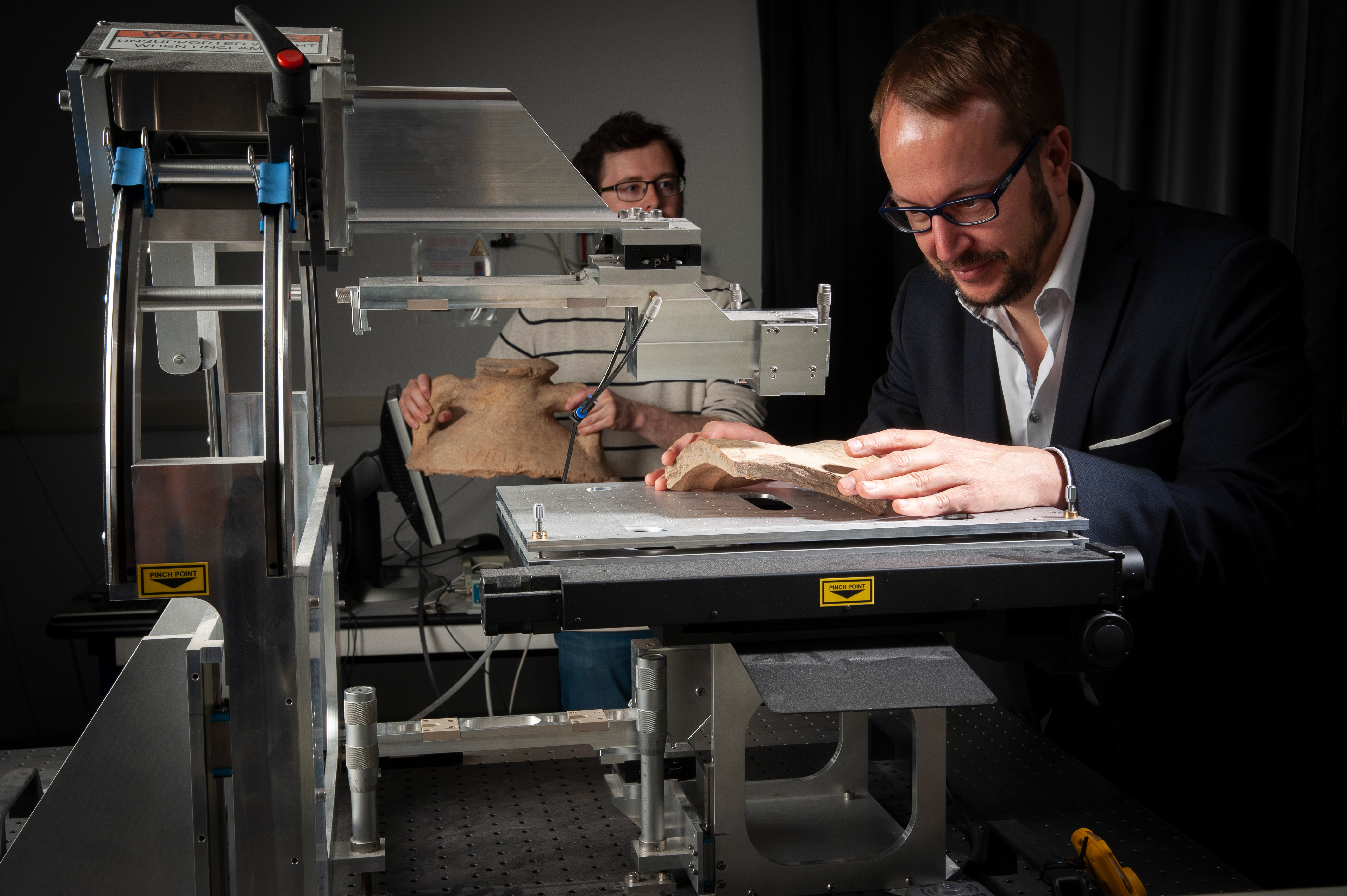
Research partnership between Georgia Tech and the Centre National de la Recherche Scientifique, where Locquet and Citrin lead the Terahertz NDE and nonlinear dynamics group.
In the basement of the Louvre, scientists at the Center for Research and Restoration of the Museums of France (C2RMF) work at the frontier of cultural heritage preservation. Their challenge is to find non-invasive ways to probe ancient and precious artifacts to understand their structural integrity and optimal restoration paths.
Although cultural heritage scientists already use an array of advanced scientific techniques, the data from these methods cannot yet be fully integrated to provide a comprehensive, multidimensional view of each artifact. Without a holistic view of structural integrity and design, decision-making about conservation remains complex and risk-laden.
This challenge is one that Alexandre Locquet, Georgia Tech-Europe professor and research scientist at the Centre National de la Recherche Scientifique (CNRS), and Georgia Tech-Europe Professor David S. Citrin will address in an upcoming Marie Skłodowska-Curie Actions Doctoral Networks research grant project, UNVEIL (Unified Nondestructive Evaluation of Historical Artifacts), as part of the IRL 2958 Georgia Tech-CNRS, a joint research partnership between Georgia Tech and the Centre National de la Recherche Scientifique, where Locquet and Citrin lead the Terahertz NDE and nonlinear dynamics group.
As coordinator of UNVEIL, Locquet will head a consortium of 21 European organizations, whose diverse areas of expertise will combine to advance nondestructive evaluation methods for cultural heritage preservation. With a budget of 3.7 million euros, the project brings together partners such as the C2RMF, with its advanced techniques in cultural heritage science, and the IRL 2958 Georgia Tech-CNRS.
UNVEIL's goal is not only to integrate data across multiple techniques to understand cultural artifacts, but also to introduce advanced, engineering-grade methods (e.g., terahertz imaging, ultrasound, and infrared thermography) into cultural heritage science. This dual approach will provide new insights to guide conservation and restoration work, from uncovering an artist's first sketches, hidden inscriptions, and signatures to detecting structural weaknesses invisible to the naked eye.
The UNVEIL project will combine data from these non-invasive methods to create a 3D augmented-reality digital twin that shows an artifact's structural integrity and layers, revealing hidden elements, such as inscriptions and underdrawings. Collaborations with European museums and heritage institutions will bring these advances to the public, offering interactive 3D exhibits that allow visitors to explore artifacts beyond their visible surfaces.
Locquet’s research focuses on terahertz (THz) imaging and spectroscopy for nondestructive evaluation. THz imaging has already demonstrated unique scientific advancements in examining cultural heritage objects, such as deciphering illegible inscriptions on an 18th-century funerary cross, reconstructing the stratigraphy of ancient paper stacks, and revealing hidden signatures and underdrawings beneath layers of paint. These results demonstrate the potential of THz imaging to uncover details inaccessible by other means. As coordinator of UNVEIL, Locquet's role extends well beyond research. He will guide the consortium as a whole and ensure the integration of all techniques into a unified approach for cultural heritage diagnostics and restoration.
The UNVEIL project will begin in March. Locquet and his team are currently seeking doctoral students in physics and electrical and computer engineering to join the multidisciplinary research team. Interested students are encouraged to send their CV and a letter of interest to alocquet@georgiatech-metz.fr and learn more about UNVEIL.