
Better Brain-Machine Interfaces Could Allow the Paralyzed to Communicate Again
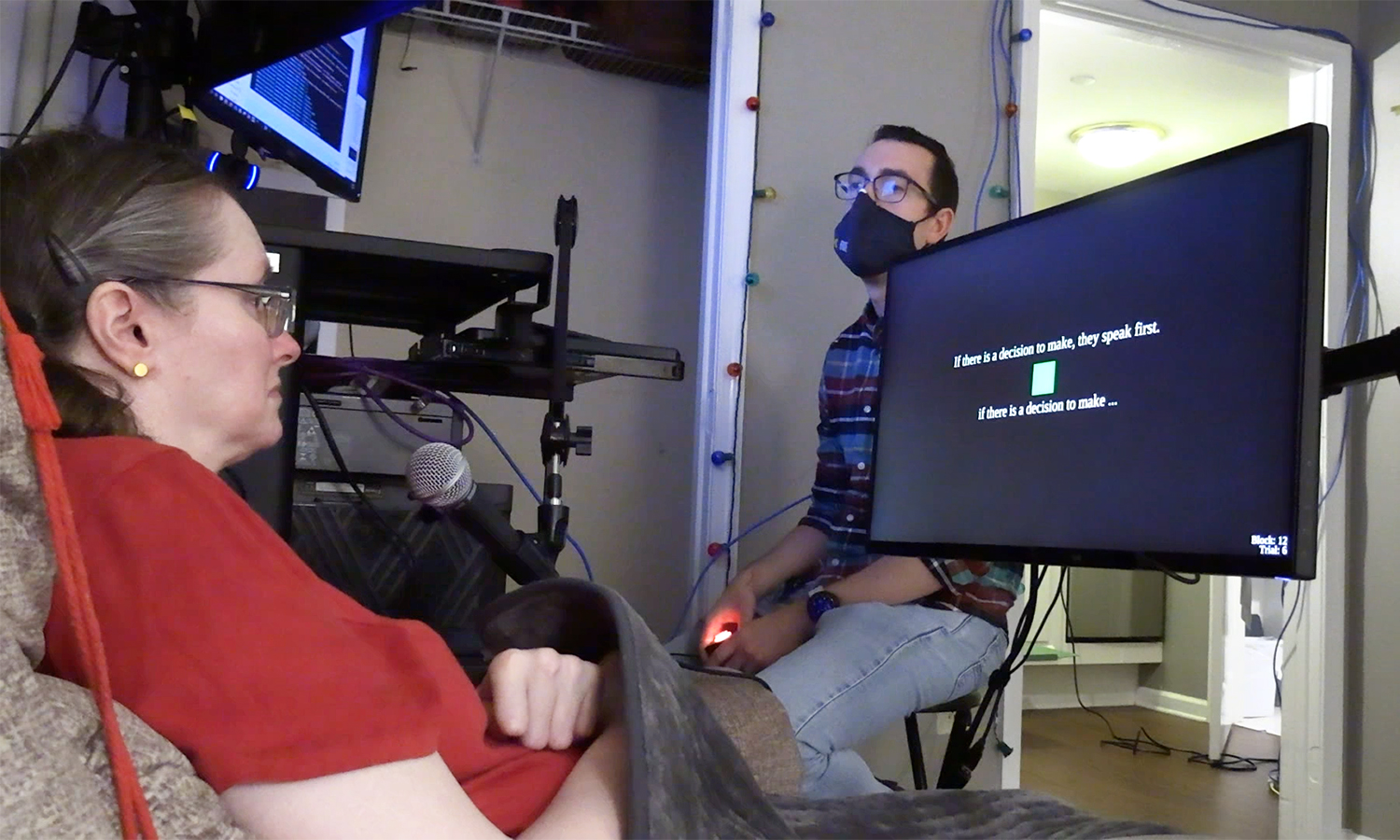
During a research session, a participant imagines saying the text cue on the screen. The bottom text is the brain-computer interface’s prediction of the imagined words. (Photo courtesy: Chethan Pandarinath)
Last summer, a team of researchers reported using a brain-computer interface to detect words people with paralysis imagined saying, even without them physically attempting to speak. They also found they could differentiate between the imagined words they wished to express and the person’s private inner thoughts.
It’s a significant step toward helping people with diseases like amyotrophic lateral sclerosis, or ALS, reconnect with language after they’ve lost the ability to talk. And it’s part of a long-running clinical trial on brain-computer interfaces involving biomedical engineers from Georgia Tech and Emory University alongside collaborators at Stanford University, Massachusetts General Hospital, Brown University, and the University of California, Davis.
Together, they’re exploring how implanted devices can read brain signals and help patients use assistive devices to recover some of their lost abilities.
Speech has become one of the hottest areas for these interfaces as scientists leverage the power of artificial intelligence, according to Chethan Pandarinath, associate professor in the Wallace H. Coulter Department of Biomedical Engineering at Georgia Tech and Emory and one of the researchers involved in the trials.
“We can place electrodes in parts of the brain that are related to speech,” he said, “and even if the person has lost the ability to talk, we can pick up the electrical activity as they try to speak and figure out what they’re trying to say.”