
Welcome Wreck: Building Community for Georgia Tech Research Faculty
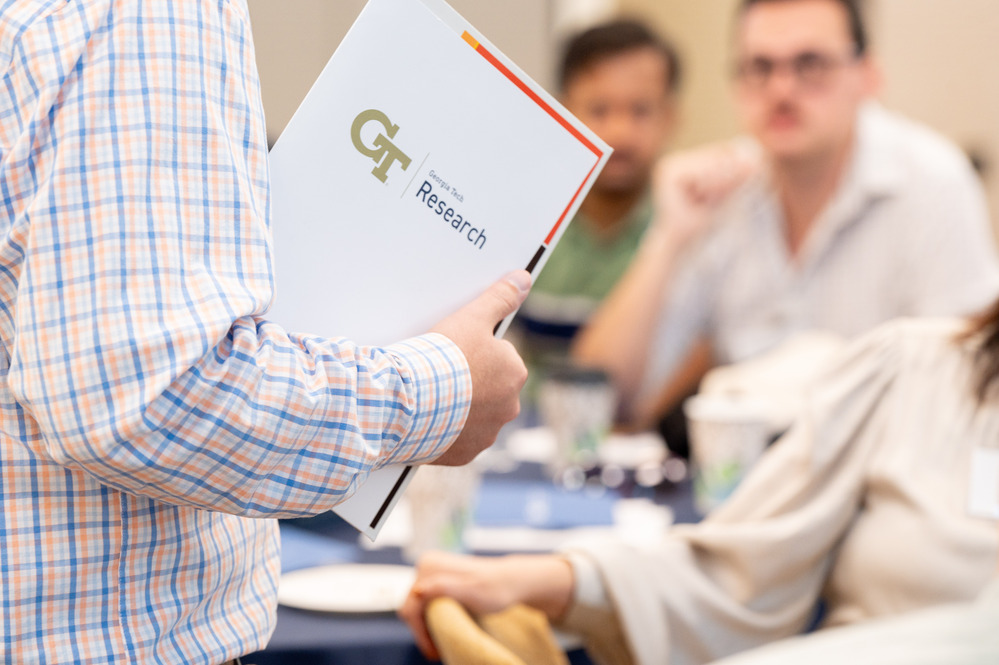
When research faculty arrive at Georgia Tech, they bring bold ideas, deep expertise, and the drive to build something meaningful. They step into labs, lead sponsored projects, mentor students, write proposals, manage teams, and push the boundaries of innovation.
But alongside the excitement of a new role comes questions:
- Who do I call when I am unsure about a process?
- How do I find collaborators outside my unit?
- What is written policy, and what is simply how things are done?
For many research faculty, the first few months at Georgia Tech are a mix of opportunity and uncertainty.
That is where Welcome Wreck comes in.
Welcome Wreck is a peer-to-peer initiative designed to ensure that new research faculty do not have to navigate those early months alone. Instead of proffering another checklist or formal training session, the program offers something simple and powerful: a conversation with a peer.
“A key predictor of research faculty success and retention is appropriate onboarding from the beginning of their employment with us,” said Maribeth Coleman, assistant vice provost for research faculty. “A priority for my office is to provide orientation opportunities to our new colleagues that help them understand the role of research faculty, the importance we have to the Institute, and to welcome them into our vibrant research faculty community.”
Welcome Wreck is the first step of this process. It is designed to ensure that new research faculty feel supported, are aware of the resources available to help them succeed in their role, and are connected to a senior colleague who can provide mentorship.
“Participating in Welcome Wreck was an incredibly meaningful experience,” said Alex Djalali, senior research engineer at Tech AI. “It offered a genuine introduction to Georgia Tech not only as a world-class institution but as a vibrant and supportive community. Because of the program, I felt truly welcomed, built new connections, and gained a deeper appreciation for the many opportunities Georgia Tech provides its students, faculty, and employees.”
Each newly hired research faculty member who participates is matched with an experienced research faculty ambassador from across campus. These ambassadors understand the nuances of this career pathway because they have walked it themselves. They know the formal systems and the informal ones. They know the policies and the unwritten norms.
Zerrin Ondin-Fraser, a research scientist at the Center for Inclusive Design and Innovation, serves as lead ambassador for Welcome Wreck. She explains that the program is rooted in lived experience:
“When I first joined Georgia Tech as research faculty, I quickly realized how much of the role you learn by doing,” explained Ondin-Fraser. “There are formal processes and policies, but there are also unwritten norms, informal networks, and everyday questions that do not always fit into an onboarding checklist. Welcome Wreck was created to bridge that gap. It is about making sure that new research faculty do not have to navigate those first months alone. By connecting colleagues who have lived this pathway, we are building a culture of mentorship, shared insight, and belonging that strengthens not only individuals but Georgia Tech’s entire research enterprise.”
The format of Welcome Wreck is intentionally flexible. Meetings can happen over coffee, in an office, or virtually. Some conversations focus on grant strategy, while others explore career pathways, interdisciplinary collaboration, or simply how to make a large campus feel smaller. The goal is that they all, no matter the format, create the feeling of being welcomed into a community.
Those early connections matter. Research faculty often work across disciplines, centers, and institutes. Building networks beyond one’s immediate unit can open doors to collaboration, new funding opportunities, and long-term partnerships.
“As a new research faculty member navigating the Georgia Tech ecosystem, Welcome Wreck provided helpful guidance [for me] to understand my role and how I could connect with other research faculty on campus,” explained Lucas Clay, extension professional at the Ray C. Anderson Center for Sustainable Business. “The impact extended well beyond that first meeting. Since participating in Welcome Wreck about five months ago, I have already had the opportunity to participate in multiple grants with other Georgia Tech research faculty and learn about initiatives on campus that may have gone unnoticed without the guidance I received from the Welcome Wreck team.”
Welcome Wreck complements formal HR onboarding by adding a human layer of connection grounded in shared experience and peer guidance. It creates space for honest questions, real stories, and practical insight. Welcome Wreck turns what could feel like a solitary transition into a connected beginning.
Open to all newly hired research faculty across Georgia Tech, Welcome Wreck reflects a simple perspective: Strong research communities are built not only through projects and proposals but through relationships.
“Whether you’re in your first week or a few months into your role, it is never too late to connect,” said Ondin-Fraser.
The program operates on a rolling basis, allowing new research faculty to join at any point during the year.
New research faculty interested in participating are encouraged to reach out at zondin6@gatech.edu or visit the Welcome Wreck program page to learn more.