
New Mobile App Turns Phones into At-Home Fetal Heart Monitors
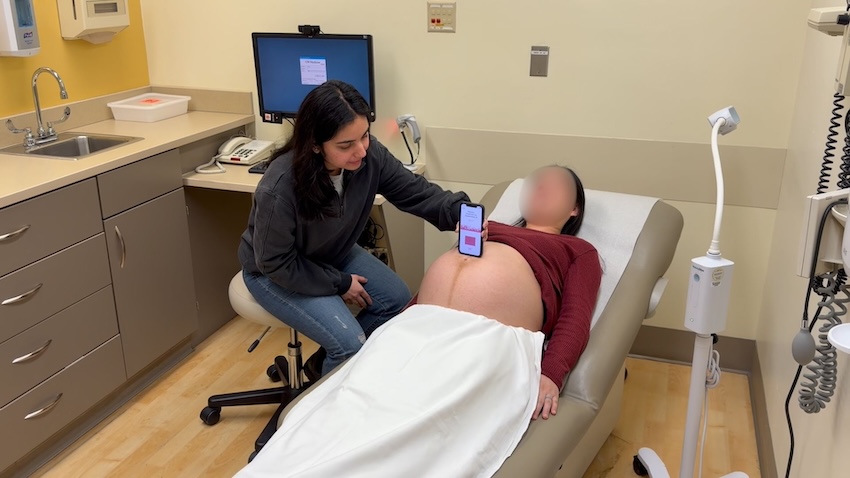
A new mobile app will soon put the ability to monitor a baby’s prenatal heartbeat in the hands of pregnant women who may worry about their baby’s health in between doctor’s visits.
Studies show that one in five pregnant women experiences perinatal anxiety, which is characterized by intense negative thoughts about their pregnancy.
DopFone turns any smartphone speaker into a Doppler radar by emitting a low-pitched ultrasound and detecting reflected signals of abdominal surface vibrations caused by a fetal heartbeat.
Alex Adams, an assistant professor in Georgia Tech’s School of Interactive Computing, said he came up with the idea for DopFone as he and his wife, Elise, experienced two miscarriages. At the time, she couldn’t reliably measure the fetal heart rate with a standard fetal Doppler monitor.
Those experiences exposed gaps in the maternal healthcare process.
“There are a lot of great devices in hospitals and clinics, but there’s not much outside of those venues, even for high-risk pregnancies,” Adams said. “This is about filling the gaps between checkups.”
Poojita Garg joined Adams to work on DopFone while completing her master’s degree at Georgia Tech. She is now pursuing her Ph.D. at the University of Washington and is co-advised by Professor Swetak Patel, who earned his Ph.D. from Georgia Tech in 2008.
Garg is working with the University of Washington School of Medicine to conduct DopFone’s first clinical trials.
Garg tested DopFone on 23 patients and achieved a plus-minus of 4.9 beats per minute, well within the clinical standard range of eight beats per minute for reliable fetal heart rate measurement.
Adams said it measured within two beats per minute in most cases, with an error rate of less than one percent.
About one million pregnancies in the U.S. end in miscarriage, according to a study from the Yale School of Medicine, and doctors know little about what causes them. Adams said that number is probably higher because many go unreported.
Adams and Garg said it’s unclear whether the innovation could reduce the number of miscarriages. However, consistent fetal heart rate data collection outside of the doctor’s office could provide a better idea of what happens leading up to a miscarriage.
“From there, we can take preventative action,” Adams said. “If nothing else, we can give a sense of comfort to those who may be worried.”
Expanding Access
While couples can purchase portable fetal heart rate monitors, Adams and Garg see DopFone as a low-cost alternative for those who live in areas with limited or inaccessible healthcare systems.
“There’s a lot of potential for using it in what doctors like to call maternity deserts,” Garg said. “These are areas where a pregnant person, at the time of delivery, would have to travel long distances to reach a hospital. This technology will be useful globally in underdeveloped areas of the world.”
The researchers also mentioned that external add-ons and attachments aren’t part of their design goals. They prefer to rely on the phone’s built-in features to keep the technology accessible.
“The real value is that 96% of America already has the technology in their pocket, along with 60% of the world’s population,” Adams said. “Half of the battle is having the right tools. The more we can get from what’s already in the phone, the more we can guarantee people have access to it.”
Not a Substitute
Some patients may feel a constant need to check their unborn child’s heart rate, and Garg acknowledged that a tool like DopFone could increase that anxiety. She and Adams said a future version of the app will tell the parent if the heart rate is within a healthy range.
“There’s a lot of tradeoffs between a tool that could provide reassurance or create anxiety,” she said. “We want the use of this tool to be recommended by a doctor and for doctors and their care teams to be kept in the loop.”
She also said DopFone is not meant to replace anything that is done in a clinic.
“There are devices that make the whole process possible at home, but this is something that should be done in a clinic, so that’s the line we want to draw,” she said.