
Smarter, Faster, and More Human: A Leap Toward General-Purpose Robots
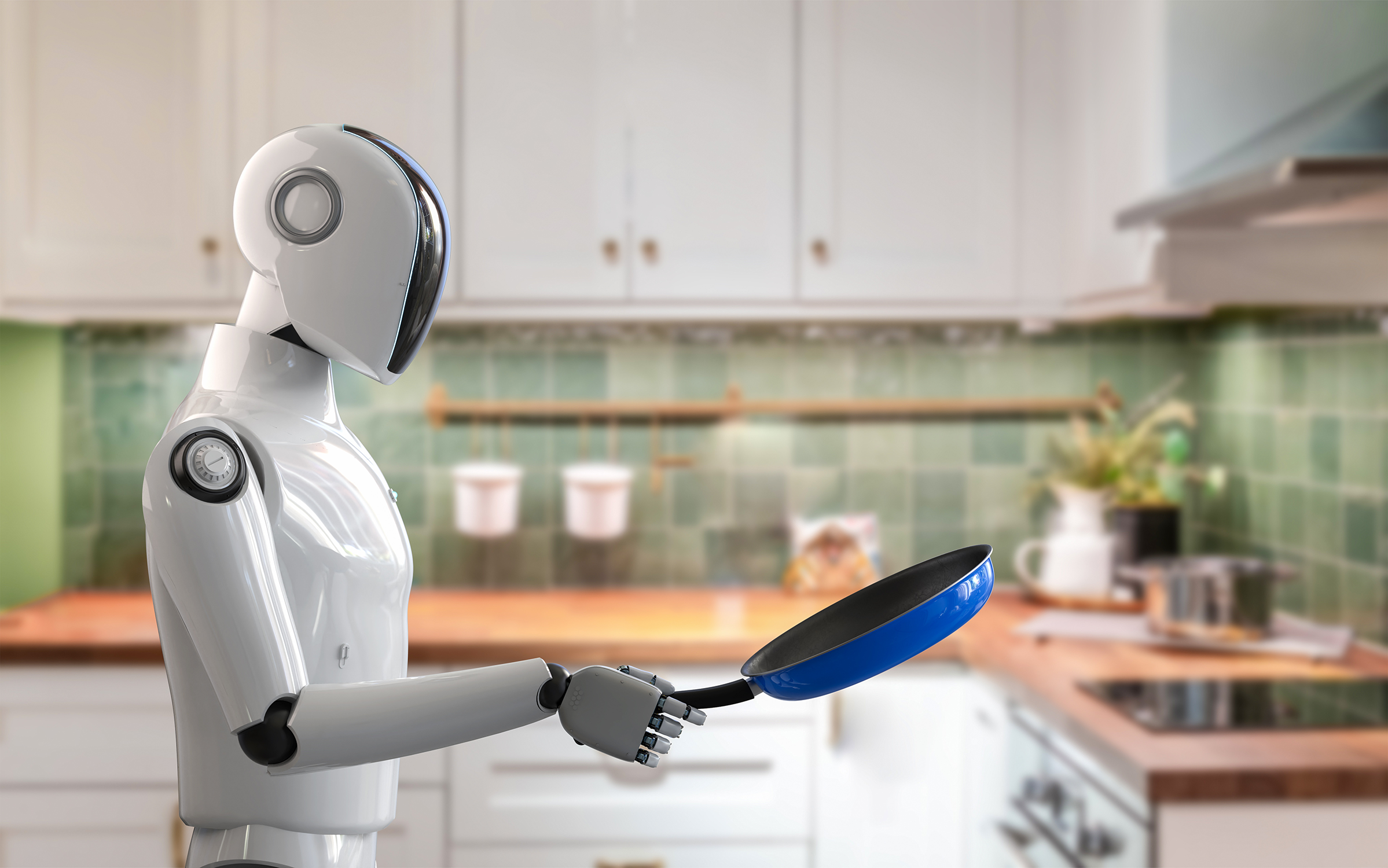
Pancake-flipping robots could be just around the corner thanks to a new robot learning system from Georgia Tech. (Credit: Adobe Stock)
Robots are increasingly learning new skills by watching people. From folding laundry to handling food, many real-world, humanlike tasks are too nuanced to be efficiently programmed step by step.
With imitation learning, humans demonstrate a task and robots learn to copy what they see through cameras and sensors. While at the leading edge of robotics research, this approach is limited by a major constraint: Robots can only work as fast as the people who taught them.
Now, Georgia Tech researchers have created a tool that smashes that speed barrier. The system allows robots to execute complex tasks significantly faster than human demonstrations while maintaining precision, control, and safety.
The team addresses a central challenge in modern robotics: how to combine the flexibility of learning from humans with the speed and reliability required for real-world deployment. The technology could lead to wider adoption of imitation learning in industrial and household applications and even enable robots to execute humanlike tasks better than ever before.
“The thing we’re trying to create — and I would argue industry is also trying to create — is a general-purpose robot that can do any task that human hands can do,” said Shreyas Kousik, assistant professor in the George W. Woodruff School of Mechanical Engineering and a co-lead author on the study. “To make that work outside the lab, speed really matters.”
The new tool, SAIL (Speed Adaptation for Imitation Learning), was born out of a cross-campus, interdisciplinary collaboration that brought together expertise in mechanical engineering, robotics systems, and machine learning. The research team includes Kousik; Benjamin Joffe, senior research scientist at the Georgia Tech Research Institute; and Danfei Xu, assistant professor in the School of Interactive Computing, along with graduate students and researchers from multiple labs.
Speed Without Sacrifice
Teaching robots to work faster than the speed of human demonstrations is challenging. Robots can behave differently at higher speeds, and small changes in the environment can cause errors.
“The challenge is that a robot is limited to the data it was trained on, and any changes in the environment can cause it to fail,” Kousik said.
SAIL addresses this challenge through a modular approach, with separate components working together to accelerate beyond the training data. The system keeps motions smooth at high speed, tracks movements accurately, adjusts speed dynamically based on task complexity, and schedules actions to account for hardware delays. This combination allows robots to move quickly while staying stable, coordinated, and precise.
“One of the gaps we saw was that our academic robotics systems could do impressive things, but they weren’t fast or robust enough for practical use,” Joffe said. “We wanted to study that gap carefully and design a system that addressed it end to end.”
He added, “The goal is not just to make robots faster, but to make them smart enough to know when speed helps and when it could cause mistakes.”
The team evaluated SAIL’s performance across 12 tasks, both in simulation and on two physical robot platforms. Tasks included stacking cups, folding cloth, plating fruit, packing food items, and wiping a whiteboard. In most cases, SAIL-enabled robots completed tasks three to four times faster than standard imitation-learning systems without losing accuracy.
One exception was the whiteboard-wiping task, where maintaining contact made high-speed execution difficult.
“Understanding where speed helps and where it hurts is critical,” Kousik said. “Sometimes slowing down is the right decision.”
While SAIL does not make robots universally adaptable on its own, it represents an important step toward robotic systems that can learn from humans without being constrained by human pace.
By showing how learned robotic behaviors can be accelerated safely and systematically, SAIL brings imitation learning closer to real-world use — where speed, precision, and reliability all matter.
Citation: Ranawaka Arachchige, et. al. “SAIL: Faster-than-Demonstration Execution of Imitation Learning Policies,” Conference on Robot Learning (CoRL), 2025.
DOI: https://doi.org/10.48550/arXiv.2506.11948
Funding: The authors would like to acknowledge the State of Georgia and the Agricultural Technology Research Program at Georgia Tech for supporting the work described in this paper.
Additional Media
Video: Smarter, Faster, and More Human: A Leap Toward General-Purpose Robots