
What do hurricanes, new nanomaterials, and blood flowing through the human body have in common?
Each raises scientific questions that are extraordinarily hard to answer. How will a storm evolve? How will a material behave under different conditions? How does blood move through the body, down to individual cells? Answering questions like these can take an enormous amount of computation.
That’s where supercomputers come in.
Supercomputers let researchers study problems that would be difficult or impossible to understand with physical experiments or ordinary computers alone. They’re also increasingly used for artificial intelligence (AI), where training sophisticated models takes vast computing power.
But what, exactly, makes a computer “super”? And what happens inside one that lets it work at such scale?
Here’s a look inside supercomputing, and at Nexus, Georgia Tech’s new supercomputer funded by the National Science Foundation (NSF).
What is a supercomputer?
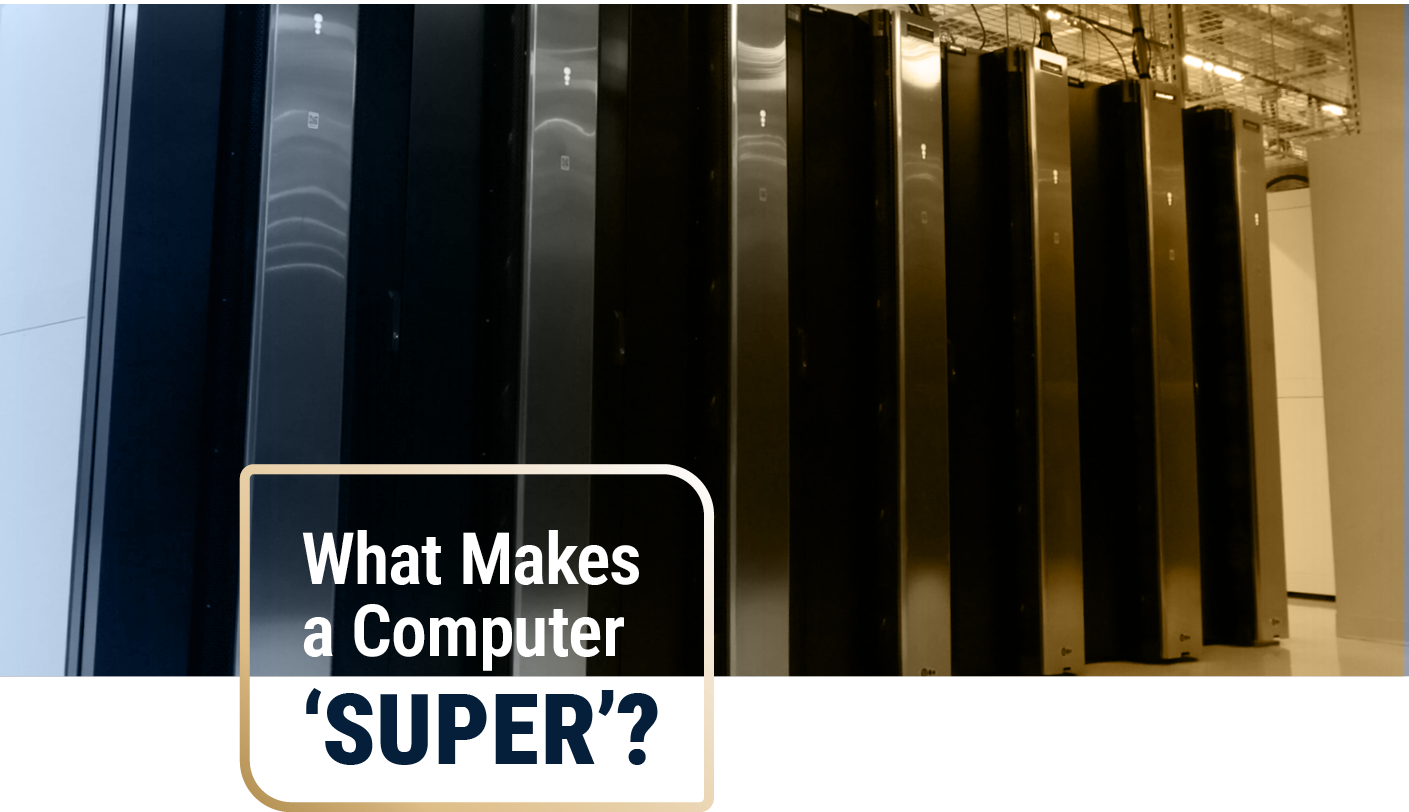
A supercomputer is a computer system built to handle extremely large or complex calculations — problems that would take a regular computer far too long to solve.
How is a supercomputer different from a regular computer?
A supercomputer splits a big problem into smaller pieces and works on many of them simultaneously. This approach is called parallel computing, which links together many individual computers, each with its own processors and memory. A very fast network connects them so they can share data and work as a single system.
Imagine modeling a hurricane. A supercomputer divides the atmosphere into millions of small 3D boxes and gives groups of them to different processors. Each processor calculates what’s happening in its boxes at the same time as the others and shares results with its neighbors.
How is AI changing supercomputing?
Training large AI models takes enormous computing power. Researchers are also blending AI with traditional scientific computing using simulations, large datasets, and AI models together in the same project. That means today’s supercomputers need to handle both kinds of work.
So, what makes Nexus “super”?
Nexus is built for that blended work. It combines traditional high-performance computing with AI and cloud-based services, so researchers can run complex projects that need immense computing power over long periods of time.
What else makes Nexus significant?
At least 90% of Nexus’ capacity is available to researchers across the U.S. This means more scientists will have the computing power to take on challenges — from drug discovery to aerospace research — too big for any regular machine.
How can researchers access Nexus?
Georgia Tech runs this system, which is the first national academic supercomputer the Institute has hosted. Researchers can apply for usage time through a peer-reviewed process coordinated by the NSF.